AI-generated vision board images: when they help and when they hurt
AI can put your face at the finish line. That can strengthen a goal or turn it into a fantasy that lowers effort. When generated images help, when they hurt, how to use them honestly.
A new kind of vision board tool has arrived. Upload a few selfies and it puts you at the finish line, in the corner office, on the beach in Bali. The results can be startlingly good, and the appeal is obvious: a stranger on a yacht is a stranger, but this is you. We are building a version of this ourselves, so we have thought about it more than most, and the honest answer is that it can help and it can hurt, depending on how it is used.
The case for: a picture of you is harder to dismiss
Vision boards fail partly because stock photos read as advertising, and years of scrolling have taught your brain to ignore advertising. A photo with your own face in it does not get filtered the same way. People in tests of these tools describe the same reaction: it looks like me, so it feels possible. For goals you cannot photograph yet, the flat you have not bought, the race you have not run, a generated image can do what no stock photo does, which is make the outcome specific to you.
The case against: the more vivid the fantasy, the less you do
This is the part the generators do not mention. Gabriele Oettingen’s research on positive fantasies, across two decades and many studies, found that vividly imagining a desired outcome, without also confronting the obstacle, lowers effort and predicts worse results. In one line of work with Heather Kappes, fantasising measurably reduced energy, as if the mind treated the picture as partly achieved.
An AI image of you already there is the most vivid possible fantasy. It is the perfect tool for feeling finished before you start. If the whole board is generated scenes of your future self, with nothing under the images, you have built exactly the thing the research warns about, only more convincing.
The line that decides it: is there an action under the image?
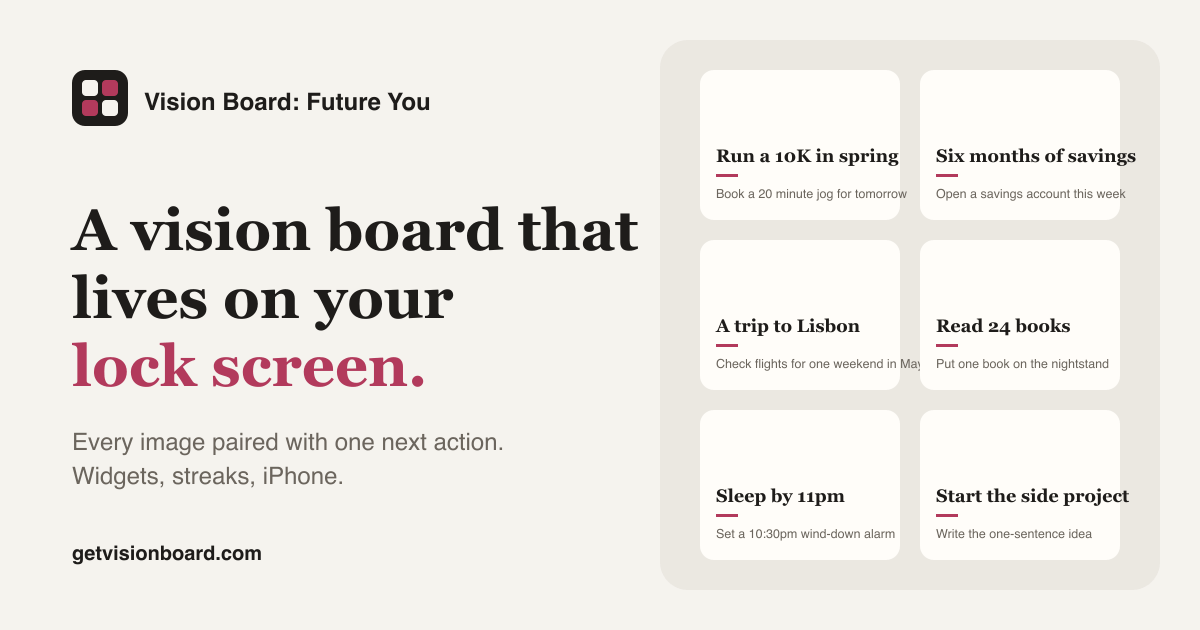
Oettingen’s remedy is mental contrasting: picture the outcome, then picture the obstacle, then make a plan for the obstacle. On a board, the compact version is a next action under every image, something you can finish this week. With that line present, a generated image of you at the finish line sits above register for the race and book Saturday’s long run, and the vividness works for you. Without it, the same image works against you.
This is why our app will not save a tile without a next action, and why the Future You scenes we are building for version 1.1 are added to tiles that already have one, rather than generating a whole board of fantasies.
Where generated images earn their place
Use them for a minority of tiles, not the whole board, and only where a real photo is impossible. The unbought flat, the unrun race, the country you have not moved to yet. Keep the scene specific and modest: you at the desk in the new job, not you on a stage. Specific scenes point at actions; grand ones point at daydreams. And keep your own real photos for everything you already have a piece of: the running shoes, the current kitchen, the friends you want more time with. Memory beats fantasy.
What to check before you upload your face
A selfie is biometric data in most legal frameworks, and Apple’s guidelines since late 2025 require explicit consent before an app shares personal data with a third-party AI service. Before uploading, look for four things: a consent screen that names the provider that generates the image, a stated retention period, a way to delete your photos, and a statement that they are not used to train models or for advertising. If any of the four is missing, the app is keeping your face for reasons it is not telling you.
For our own scenes, the answers are: the provider is named on the consent screen, photos are deleted after delivery and within seven days at the latest, deletion is one tap or one email, and no training or ad use. The privacy policy spells it out.
An honest test for any generated tile
Look at the image and ask what you will do this week because of it. If the answer is nothing, the tile is decoration and the vividness is costing you energy. Either write the action or delete the image. A board that passes this test for every tile can use AI images safely. A board that fails it is a beautiful reason to relax.
You can try the format without any AI at all in the free maker: captions and next actions first, pictures second.
Main claim: AI-generated images of yourself help a vision board only when each one sits above a concrete next action; on their own they are the most convincing fantasy yet built, and fantasies lower effort.
Get the app
Put your board on your lock screen and widgets, pair every image with one next action, keep a streak. Free 7-day trial on iPhone.
Get the appOr start free in the web maker →Frequently asked questions
Are AI vision board generators worth using?
For some tiles. A generated image of you in a specific goal, paired with a next action, can make the goal feel concrete. A board that is entirely generated fantasy, with no action under any tile, is the exact pattern research links to lower effort.
Is it safe to upload my face to an AI vision board app?
Only if the app tells you which provider generates the image, how long the photos are kept, and lets you delete them. Apple requires explicit consent before an app sends personal data to a third-party AI service. If an app does not show a consent screen naming the provider, do not upload.
Do AI images work better than real photos on a vision board?
Real photos from your own life usually work better because they trigger memory rather than envy. Generated images earn their place for goals you cannot photograph yet, and only when the image is specific and the tile carries a next action.